Astigmatism exercises
Astigmatism theory
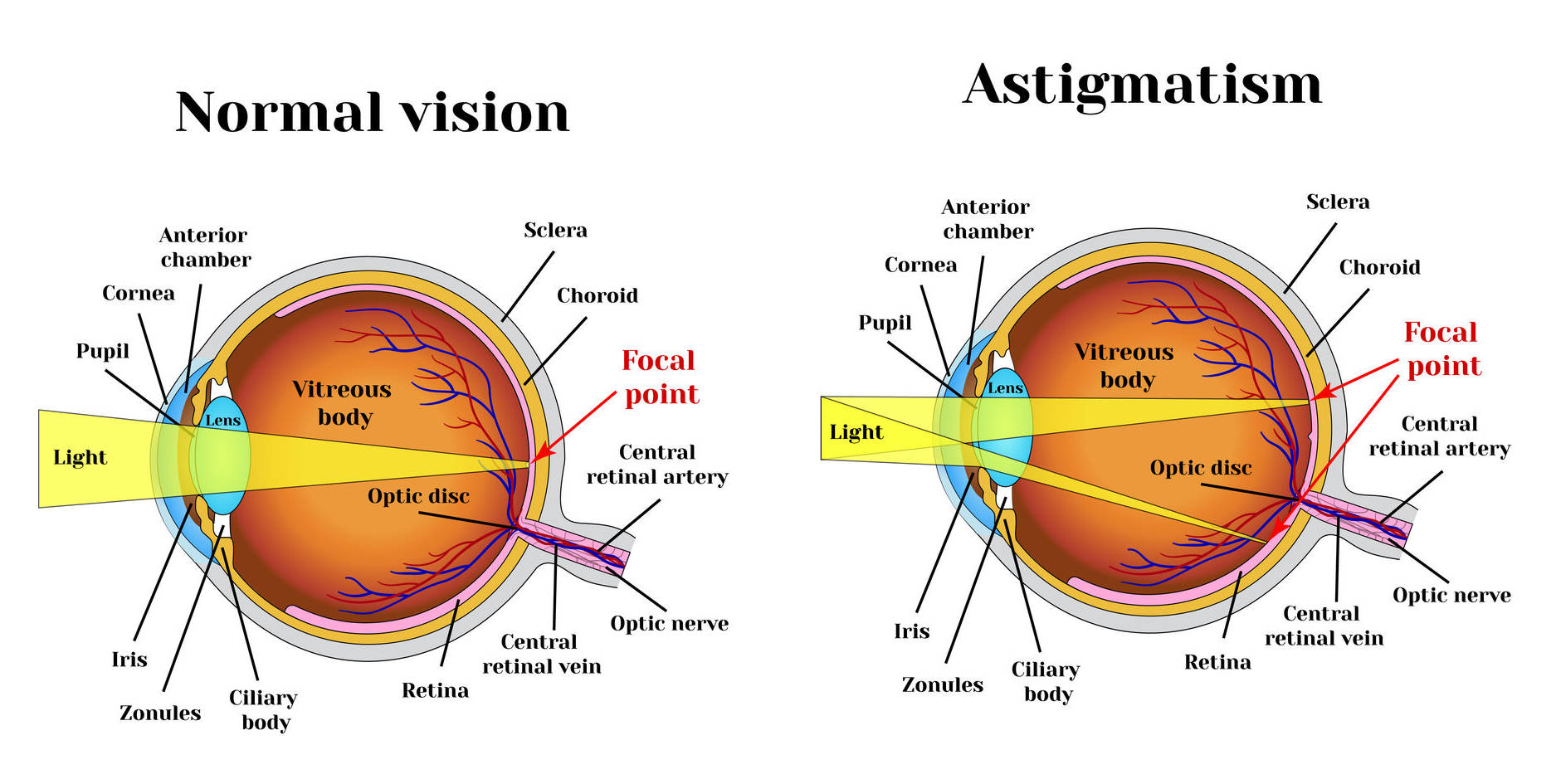
Astigmatism is a focusing disorder caused by changes in the surface of the cornea or lens, resulting in blurred and distorted images. It most often occurs together with one of the refractive errors — myopia or hyperopia.
You can find more information about this condition here.
Contrary to popular belief, astigmatism is an easy defect to correct, and the key to that is relaxation. It is also a very good example of how readily eye training deals with this type of defect. There have been cases in which small astigmatic errors (~1 diopter) were corrected in a single day using the exercises below. For larger defects, several weeks of training were usually enough. This is a significant result compared with, for example, the treatment of myopia. It seems highly likely that the cause of this defect is tension in the eye's rectus (straight) muscles. That is why the following exercises are aimed mainly at improving the condition of the rectus muscles, relaxing them, and reducing their tension. Return to the "astigmatic dial" from time to time to check your progress. We hope that eventually you will reach the point where all the lines look equally even and equally black.
Exercise A1. Relaxing the rectus muscles
This exercise is meant to gently relax the rectus muscles of the eye and should be performed before more strenuous exercises (such as the Tibetan Wheel). Because its purpose is to relax the muscles, if you feel pain while doing it, stop, rest with a short palming, and do not move on to more strenuous exercises.
- Extend your thumb in front of you at a distance of about 10 cm (4 inches) at the level of your nose. You don't need to see it sharply, as the purpose of this exercise is to relax the muscles.
- Slowly move your thumb upward (to 12 o'clock), as high as you can while still seeing it, and pause there for a moment (max. 2 seconds). You may feel muscle tension (sometimes slight pain) in this position. Then slowly return your thumb to the starting position. You should feel the muscles relax during the return movement. Continue in the same way to 2 o'clock, then back to the center, followed by 4, 6, 8, and 10 o'clock, returning to the center between each.
- During the thumb movements, breathe as follows: during the movement from the center outward, take a slow inhale (tensing the muscles), and then during the movement inward, a slow exhale (relaxing the muscles).
- Perform the exercise starting at 12 o'clock, moving clockwise; after completing the full circuit, start again at 12 o'clock, this time moving counterclockwise.
Exercise A2. Tibetan Wheel
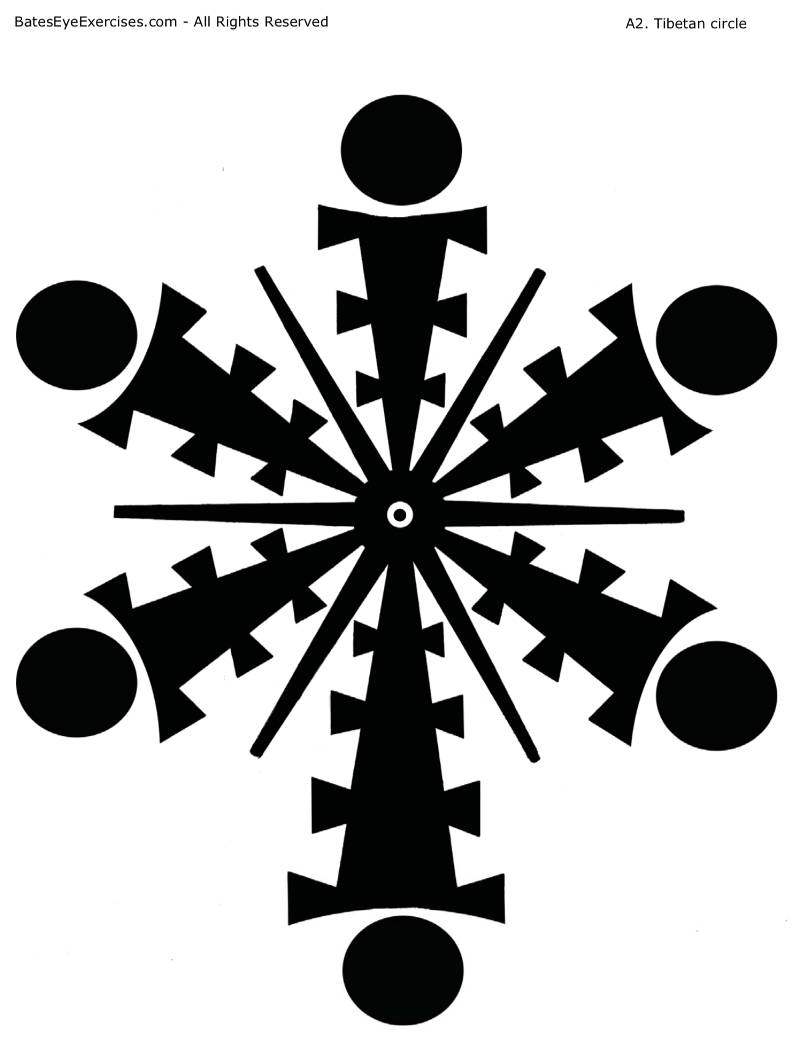
This is the most important exercise in the treatment of astigmatism: it provides deep relaxation while strengthening the muscles responsible for this defect.
- Place the chart very close to your eyes (about 2–10 cm / 1–4 inches) so that you can see the whole chart, with its center level with the tip of your nose. Do not worry if you cannot see the image sharply; the purpose of this exercise is to relax the muscles.
- Taking a slow breath in, climb the "steps" with your gaze from the center to the top. Pause for about 2 seconds, and then, while exhaling, make the return movement on the other side, descending the "steps" of the drawing. During this movement, try to feel the muscles tense as you inhale and relax on the way back as you exhale.
Exercise A3. Visualization of a ball
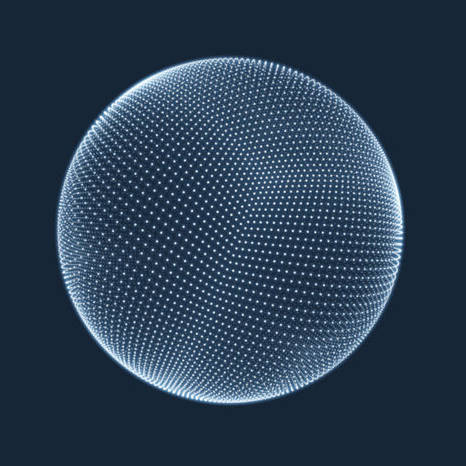
Among the visualization exercises for astigmatism, the following is well worth performing:
- Imagine a small ball the size of an eye — made of rubber, for example — located at your right eye, or just in front of it.
- Now, using your imagination, change the ball as if you were squeezing it with the fingers of one hand on its right and left sides. Picture the ball gently changing into an elliptical, "egg-like" shape, then picture your fingers releasing the pressure and the ball returning to its perfectly spherical form. Repeat 5–10 times.
Exercise A4. Eyeball massage

This exercise is best performed during palming, or right after Exercise A3 (Visualization of a Ball). It is especially helpful for those with significant astigmatism, as it helps restore the natural spherical shape of the eye.
- Place one or two fingers on the closed eyelid of each eye, one eye at a time.
- Use enough pressure to feel gentle contact, but not so much that it causes pain.
- Move your fingers left and right about 10 times, up and down about 10 times, then in circles 10 times clockwise and 10 times counterclockwise. Make small, gentle massaging movements over the eyeball.
Primary source: W. H. Bates, Perfect Sight Without Glasses (1920), ch. 9 and 6 — full text at Wikisource.