Basic Exercises
Central fixation theory
Contrary to popular belief, the area of an image seen clearly with normal vision is exceptionally small. Research shows that from a distance of twenty feet, only a spot about 1.2 cm (half an inch) across can be seen with full clarity. This means that to see a 5 cm (2-inch) letter sharply from that distance, a healthy eye must perform several micro-movements, creating multiple images that the brain combines into one sharp image of the letter. An eye with a vision defect tries to see a large portion of its field of view equally well all at once, by staring at it — causing tension and refractive errors.
Sharp vision of only a fragment of the image arises because the retina has a point of maximum sensitivity, and every other part of it is proportionally less sensitive the farther it lies from that point. In the center of the retina there is a small circular elevation called the macula lutea, or yellow spot. In the center of this spot is the fovea, a small central pit. In the middle of this depression there are no rods, and the cone cells are elongated and very tightly packed.
When learning to see an object well, it is generally most useful to think of the point you are not looking at directly as a place seen less clearly. Only when the mind agrees to see most of the object less clearly can any part of it be seen well. As relaxation deepens, the area seen less clearly expands until the best-seen part becomes just a point.
All vision-relaxing exercises lead to the recovery of normal central fixation. It can also be regained through conscious practice, and sometimes this is the fastest and easiest way to restore vision. Extremely sharp vision relies on extremely precise focusing — directing the light rays exactly onto the center of the yellow spot. Looking this way, we of course see only a very small area, but involuntary, rapid eye movements (up to 70 times per second) allow the mind to construct an image of any larger surface.
Exercise C1. Snellen chart exercise
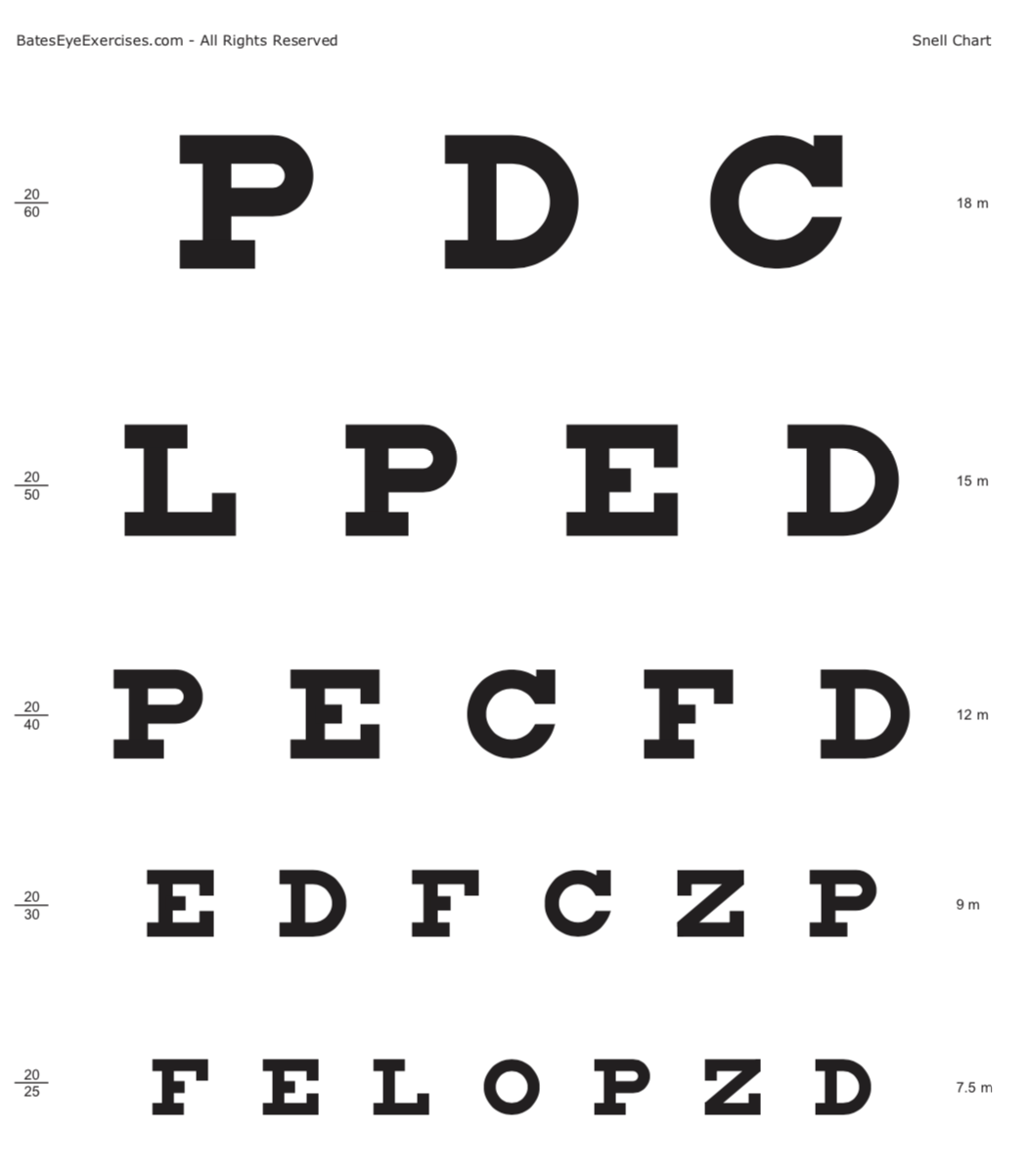
- Place the Snellen chart at a distance where the largest letter is slightly blurry. When you look at the top of the largest letter, its lower part should appear less distinct than the top. People with vision problems rarely notice this at first.
- Look around the letter and find the viewing point from which the top of the largest letter appears sharpest. Some people manage this by fixing their gaze in one place while slowly turning the head. When the chart is placed far away, some find this point of sharpest vision only after a little searching.
- After locating the point of greatest sharpness, smoothly move your gaze up and down the letter, returning to the spot you see best.
- Perform this exercise six times, then palm for a minute. Repeat this cycle for as long as it does not tire you.
Exercise C2. Dotted letter exercise
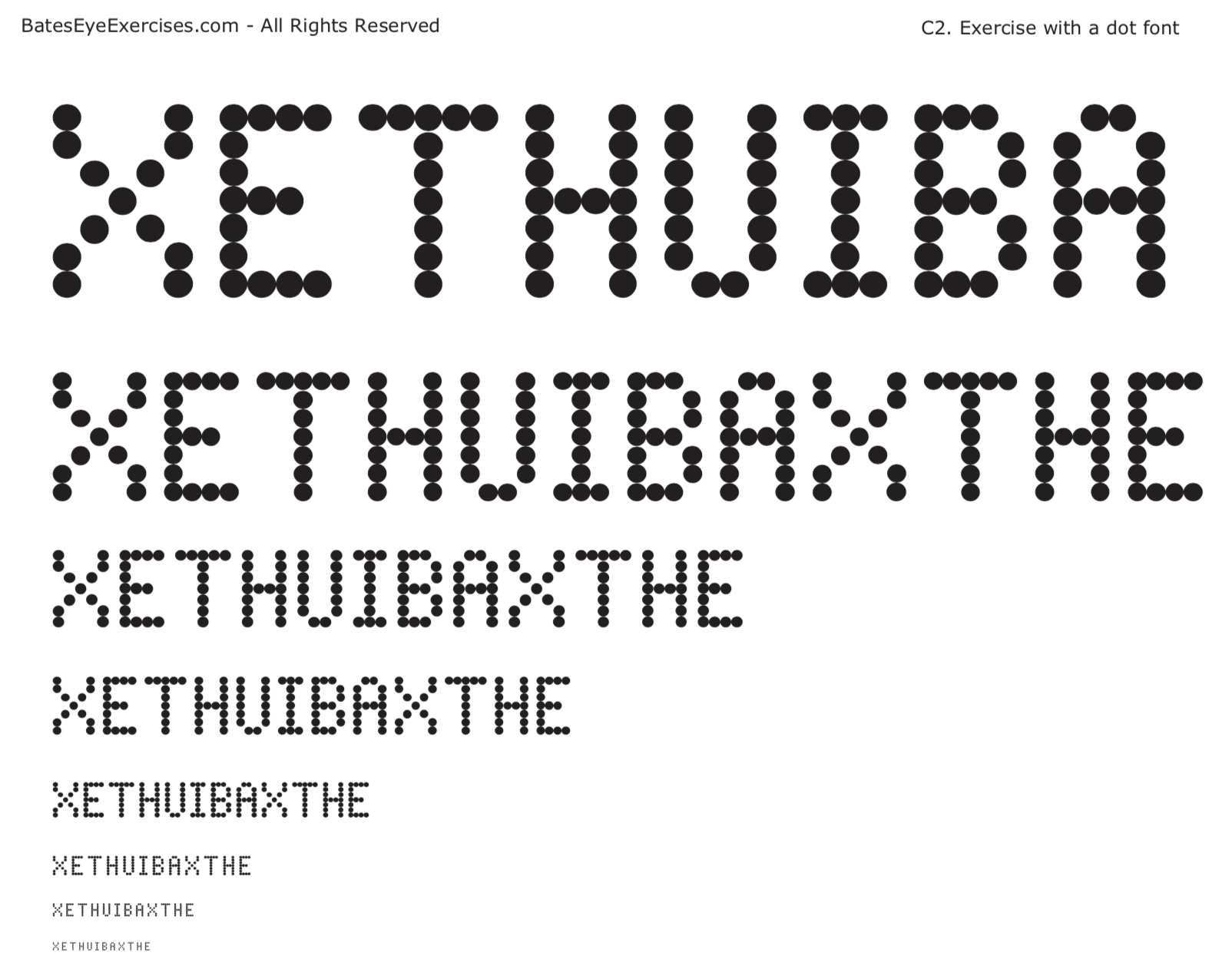
For this exercise, you will need a "dotted letter" chart. The advantage of this exercise is that the letters are drawn in dots, allowing you to improve your reading skills dot by dot, thus strengthening central fixation.
- Begin the exercise with a large font, scanning the first letter dot by dot with your eyes.
- Then look at the top of the letter while letting the bottom appear less clear. Now look at the bottom of the letter, letting the top appear less clear. You should notice an apparent movement of the letter opposite to the direction of your gaze. Repeat this 6 times.
- Now look at the right side of the letter, letting the left side appear less clear, and then the reverse — look at the left side, letting the right side appear less clear. You should notice an apparent movement of the letter opposite to the direction of your gaze. Repeat this 6 times.
Exercise C3. Domino chart exercise
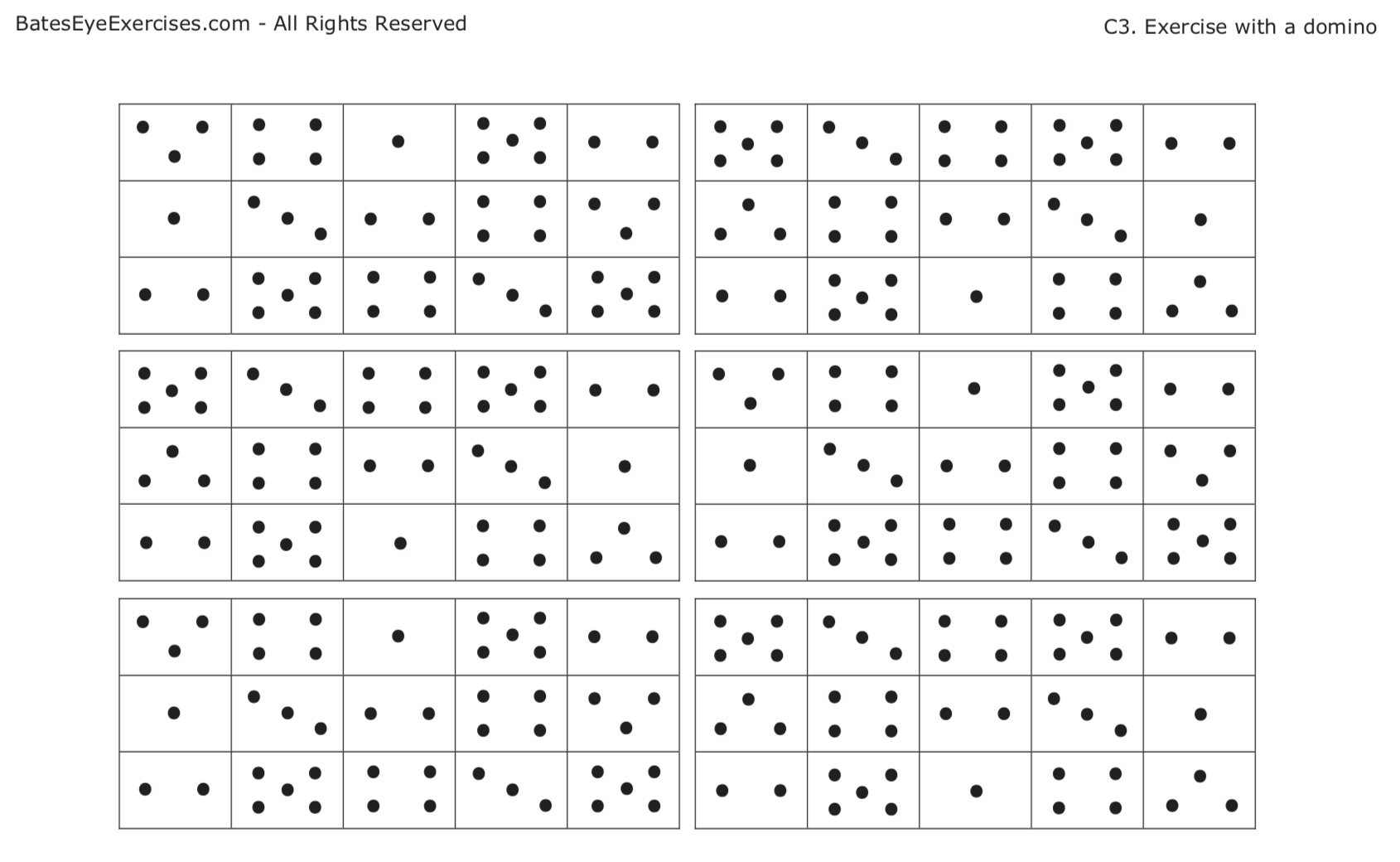
This exercise requires a domino chart.
- Place the chart in front of you at a distance where you can see the domino tiles without straining your eyes.
- Move your eyes across the rows of tiles, from left to right, then back to the left one row lower. Continue until you reach the bottom row.
- Now move your eyes down each vertical column in turn, until you reach the last one.
- Then move your eyes diagonally across the grid, until you reach the last tile.
- Now move in a zig-zag — one tile up, the next tile down — across the grid.
- You can vary the eye movements across the tiles however you like. The aim of this exercise is to make the eyes move in as many different ways as possible. Don't try to make out the pips on the tiles; just focus on moving your eyes smoothly.
Vision techniques theory
The desire to see and take in something we care about causes both psychological tension and tension in the visual system, which significantly impairs the vision process. There is an analogy with the process of remembering facts or events. As long as we strain our minds and force ourselves to remember something, our efforts are fruitless. Yet when we relax that effort and stop straining, we suddenly recall the seemingly forgotten thing after such "letting go".
The same is true for vision.
Techniques meant to give the practitioner a sense of the apparent motion of objects in the outside world, together with a sense of the eye's own stillness, were named "swinging" by Dr. Bates. They help us grasp the essence of movement, which deepens the relaxation of the body and eyes. In this way, we let our mind breathe and relax, allowing the eyes to look without straining to see.
Exercise B1. Short swinging
Choose two objects in your field of vision, preferably not too large (e.g. a window frame and a distant tree or a fragment of a building). It is important that one object is close and the other is far away.
- Stand with your feet wide apart, about 1 meter (3 feet) in front of the window, lower your arms and shoulders, relax your neck, and slowly begin to sway your body, rhythmically shifting your weight from one leg to the other. Your head stays motionless relative to your arms and swings with them like a pendulum.
- Look straight ahead without trying to see the close or distant object sharply. Try to relax — look, but don't strain to see.
- Notice that when you lean to the right, the close object (the window frame) appears to move to the left relative to the distant object (e.g. the tree). When you lean to the left, the opposite happens — the close object appears to move to the right relative to the distant object.
Exercise B2. Pencil swinging
Pencil swinging is a variation of short swinging and can be practiced in small spaces, e.g. while sitting. Here the close object can be, for example, a pencil or a finger.
- Hold a pencil or finger upright, about 15 cm (6 inches) in front of your nose.
- Looking at a distant object, sway your head from side to side, observing the apparent movement of the pencil against the background of more distant objects (e.g. a picture on the wall).
- Occasionally close your eyes and continue the apparent movement in your imagination. Each time you open your eyes, glance once at the pencil and once at the more distant objects, trying each time to observe the movement of the pencil.
Exercise B3. Long swinging
- Stand with your feet slightly apart and your hands on your hips, turning your hips, torso, and head from side to side.
- When turning to the left, shift your weight onto your left foot, lifting your right heel slightly and touching the ground with the front of your right foot (the toes).
- When turning to the right, shift your weight onto your right foot, lifting your left heel slightly and touching the ground with the front of your left foot (the toes).
- Begin the movement with your eyes, then let your torso, hips, and whole body follow. Once the turning begins, keep your gaze relaxed and let it move with your head rather than darting around; you can blink freely.
- Do not focus on any object in the moving field of view. Let your eyes sweep along with the turn, passively allowing the images to drift by without any effort to make out what is passing.
Exercise B4. Flash exercise
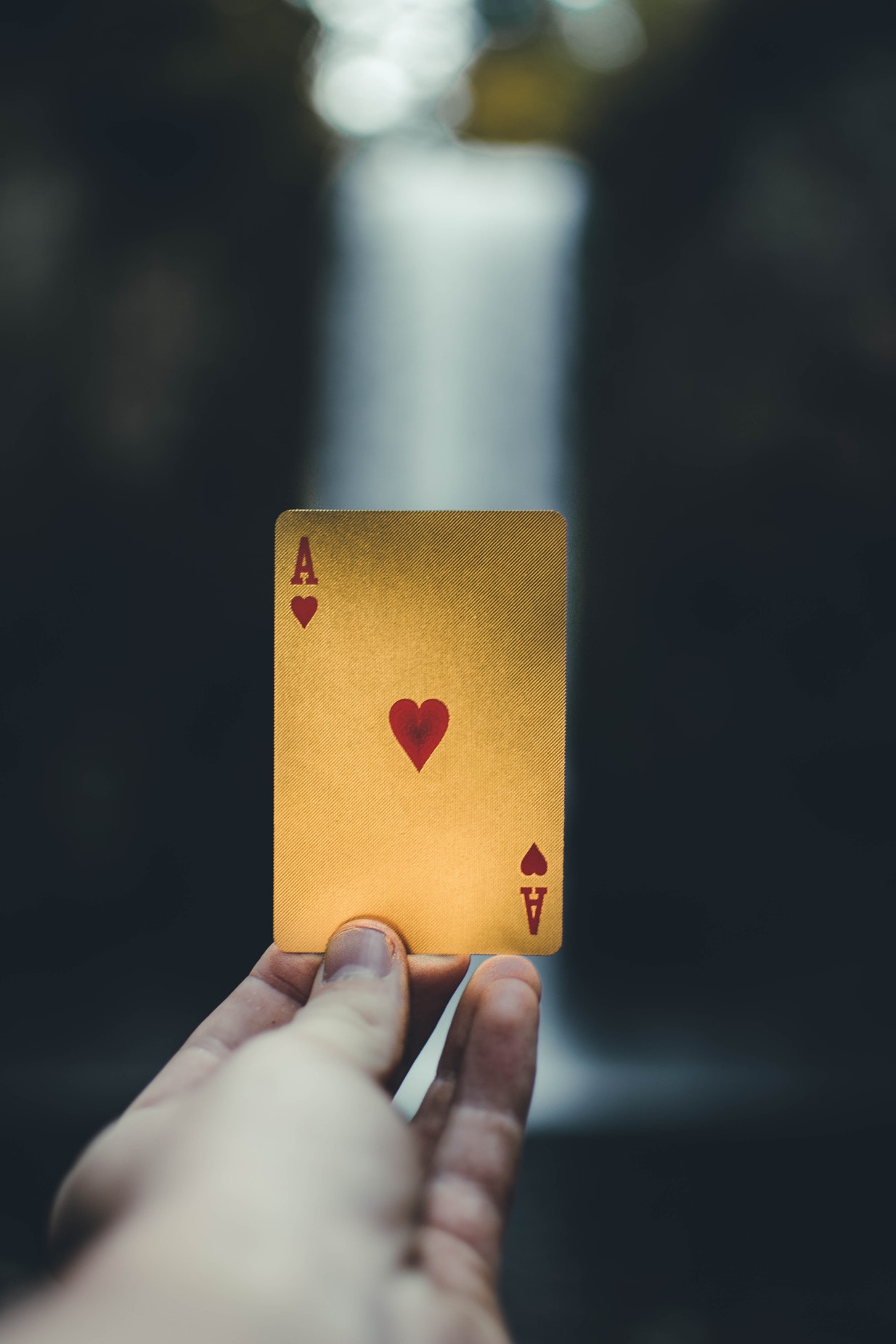
The "flash" is a way of learning to use unconscious vision and to increase the mobility of the eyes. During this exercise, the recognizing, analytical part of the mind is deliberately set aside, so that the eyes take in more than the thinking mind does. In someone with an acquired vision impairment, a brief, quick glance — with rapid, free blinking and the eyes in a state of dynamic relaxation, without the thinking mind getting involved — makes it possible to recognize and recall objects that normally cannot be seen.
- For this exercise, you need several dominoes or a deck of playing cards. Randomly choose a card or domino and look at it from arm's length for a fraction of a second, blinking freely.
- Cover your eyes and try to guess the number of dots on the domino (or the card you chose).
- Repeat the exercise with the next dominoes (or cards), practicing the flash technique.
Exercise B5. Analytical looking

Without movement, there is no vision. A state of immobility of the eye muscles and the visual organ results in a "staring" gaze, blurred and cloudy vision, and an inability to see correctly. The process of proper vision consists of minimal and continuous eye movements. People with normal vision, when carefully observing an object, keep their eyes in a position where they move continuously, minimally, and unconsciously from one point of the object to another.
The analytical looking exercise described here aims to teach you such minimal and continuous eye movements. At first, these will be conscious actions, but over time, your vision will learn to do this automatically and unconsciously.
- Looking at a building, for example, first trace its outer outline with your eyes — along the gutters, the roof, and the ground.
- Then move your gaze in turn to its windows, doors, railings, and roof tiles. Try to "trace" the outer edges of these features with your eyes. Choose shapes that are plentiful or, for example, symmetrical, so that your vision does not get bored. Jump from one feature to another, varying the type and direction of your eye movements. Do not try to see these parts of the building sharply.
- Blink freely to keep your eyes moist and give them a moment of relaxation.
Visualization theory
The work of the imagination can have an extraordinary impact on our mind and body. Each visualization technique engages the visual system, including changes in the accommodation of the eyes. These techniques will not only help us deepen eye relaxation but also strengthen the power and sharpness of our vision. They are best done during palming, when the eyes are in a state of dynamic relaxation.
Below are several examples of visualizations that you can use or create your own based on them.
Exercise W1. Sailing ship

- Sit comfortably in a chair, relax, and close your eyes.
-
Imagine that you are standing on a harbor pier,
facing a large passenger ship moored in front of you.
On its several decks you see passengers chatting, children running, and tables set out in the bar. Some people gaze toward the land, while others stroll around the decks. The huge ship slowly pulls away from the shore. As it moves off, you see fewer details on the decks. The windows and the people's figures grow smaller, and more and more of the picture is taken up by the sea around the ship. The sun is shining. The ship gradually moves farther away, becoming smaller, and fewer details remain visible. Finally, it is so far off that it becomes a tiny speck on the horizon.
- Now reverse the direction of events and let the ship slowly sail toward you from afar, growing larger. You gradually begin to see more details on the decks, to recognize people and various parts of the ship. Let it come closer and closer until it reaches the pier where you are standing.
- Repeat the ship's moving away and approaching several times in your mind, gradually speeding up the process. Each time, the ship should reach the horizon and become barely visible — a tiny speck.
- Without interrupting the image of the receding and approaching ship, try to notice how this visualization affects your eyes and their movement. Although it is done with closed eyes, this exercise has an excellent effect on the muscles and refraction of the eyeball. It is also wonderfully relaxing.
Exercise W2. Runners on a track
- Sit comfortably in a chair, relax, and close your eyes.
-
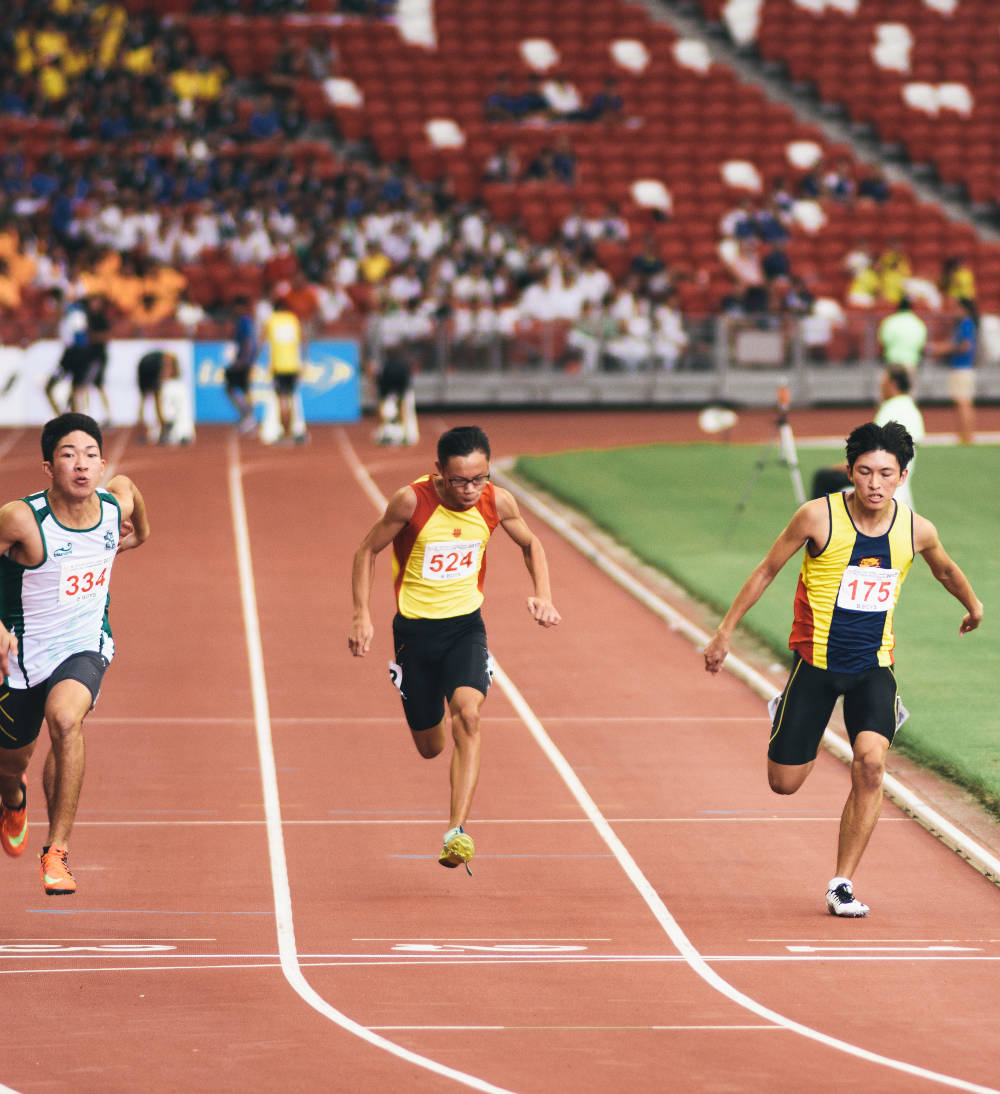
Imagine that you are standing at the start of a race on a large elliptical track.
Several runners are lining up for the race, and you will be watching them from the start/finish line. Look at them closely and take in as many details as you can of their outfits and behavior. Now imagine the race beginning: you watch as the runners move off along the elliptical track, getting farther away from you. You see fewer and fewer details as they recede, until they become just tiny dots at the farthest point of the track.
- Now the runners, still circling the track, gradually approach the finish line — and you. You notice more and more details: their outfits, expressions, and behavior. They come closer and closer until they reach the finish line where you stand.
- Replay the runners moving away and approaching several times in your mind, gradually speeding up the process. You can vary this visualization, for example by adding hurdles.
Exercise W3. Flexible disc
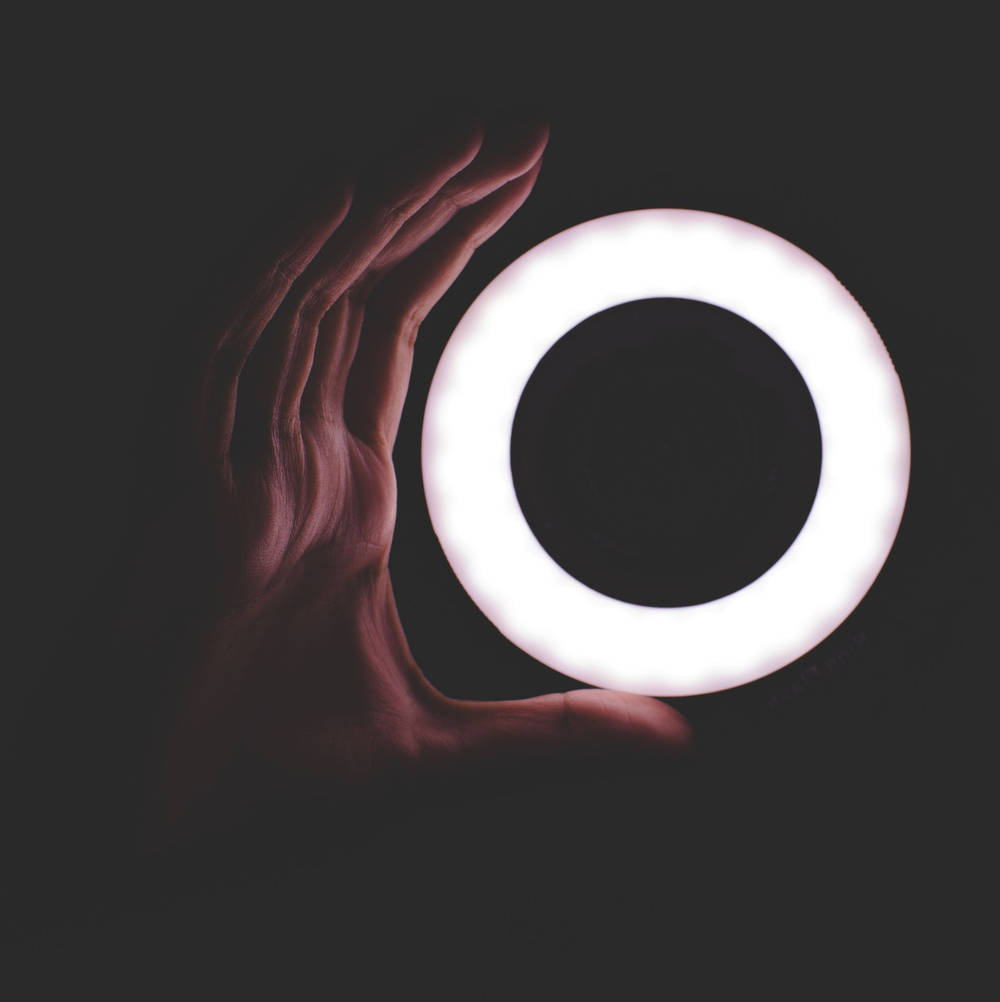
This exercise lets us experience how strong and continuous the muscle movements are while we visualize an object in motion. Although the eyes are closed and "do not see," all the muscles responsible for refraction and accommodation keep working — and working properly — in a state of dynamic relaxation.
- Imagine that you are holding a flexible rubber disc that bends easily into an ellipse when squeezed, but springs back to its original circular shape as soon as the pressure is released.
- Visualize pressing your index finger and thumb against the sides of the disc, forming a vertical ellipse. Hold this image for a moment, then relax your hand and let the disc return to its original shape. Repeat 5–10 times.
- Now move your thumb and index finger from the sides of the disc to its top and bottom. Imagine squeezing the disc into a horizontal ellipse. Repeat 5–10 times.
- Each time, imagine your hand pressing on the disc (this is very important during the exercise).
Exercise W4. Drawing mandalas
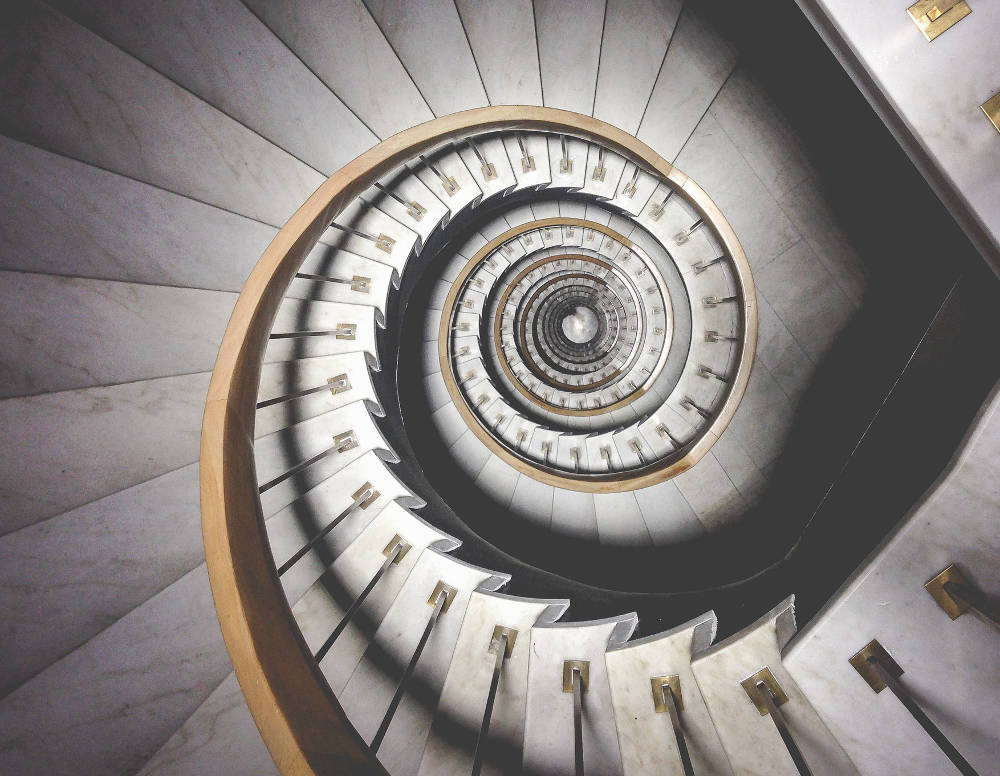
Excellent results come from drawing different shapes in your imagination with your nose — preferably mandalas, but also shapes like a treble clef, an infinity symbol, or a spiral. You can also use the shapes of letters, words, or your own signature. During the exercise, you can make gentle head movements, imagining your nose as a large pen with which you draw the chosen shapes.
Although this exercise may seem silly and childish, it is, contrary to appearances, extremely effective in vision re-education.
Primary source: W. H. Bates, Perfect Sight Without Glasses (1920), ch. 11, 13–15 — full text at Wikisource.