Myopia exercises
Myopia theory
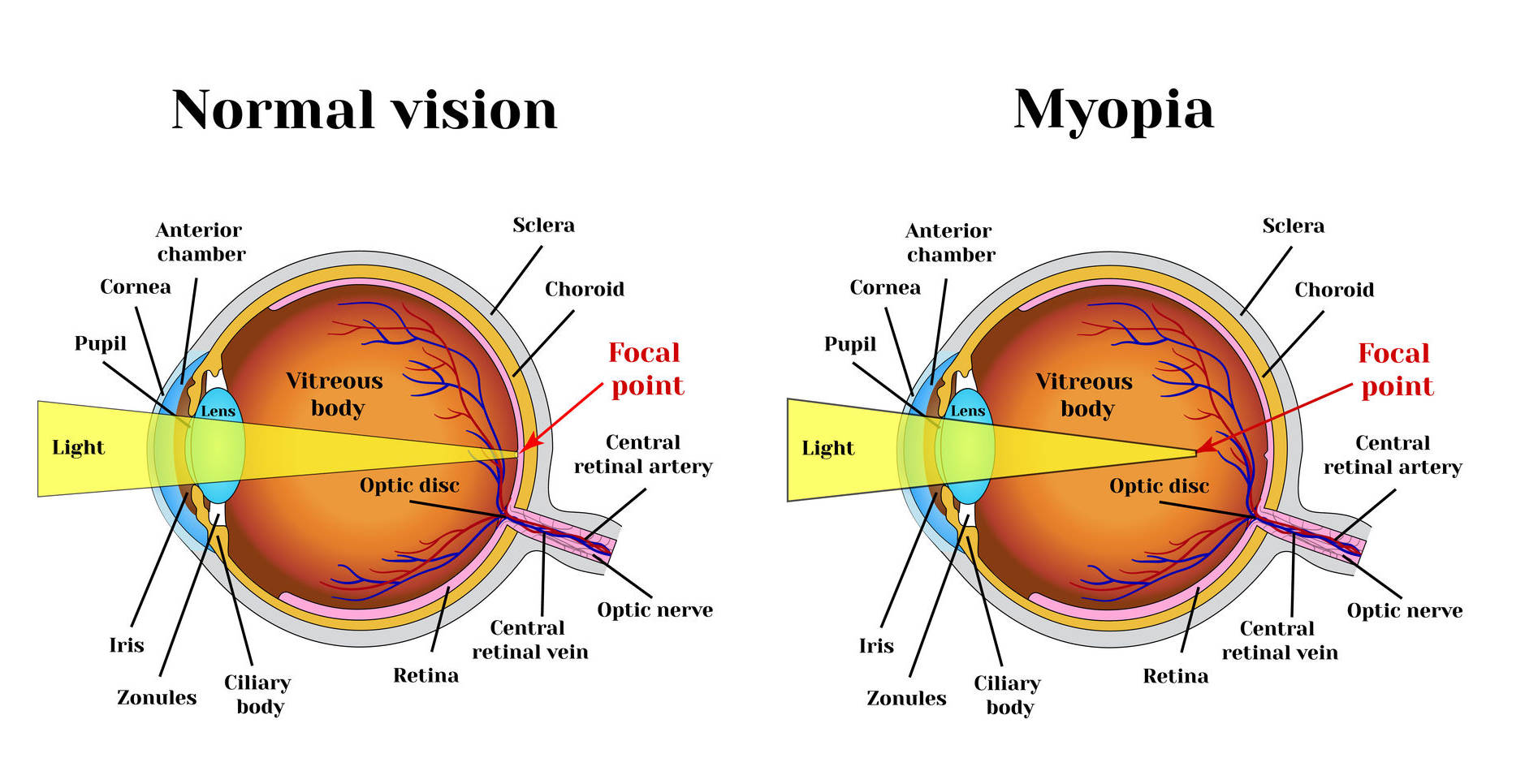
Nearsightedness (myopia) is the most common refractive eye disorder. According to some estimates, up to 30% of Europeans and as many as 60% of people in Asia are nearsighted. This defect most often develops before the age of 20. Anatomically, in nearsightedness the eyeball is elongated, so that the light rays entering the eye are focused in front of the retina instead of on it.
You can find more information about this defect here
Exercise K1. Snellen chart exercise
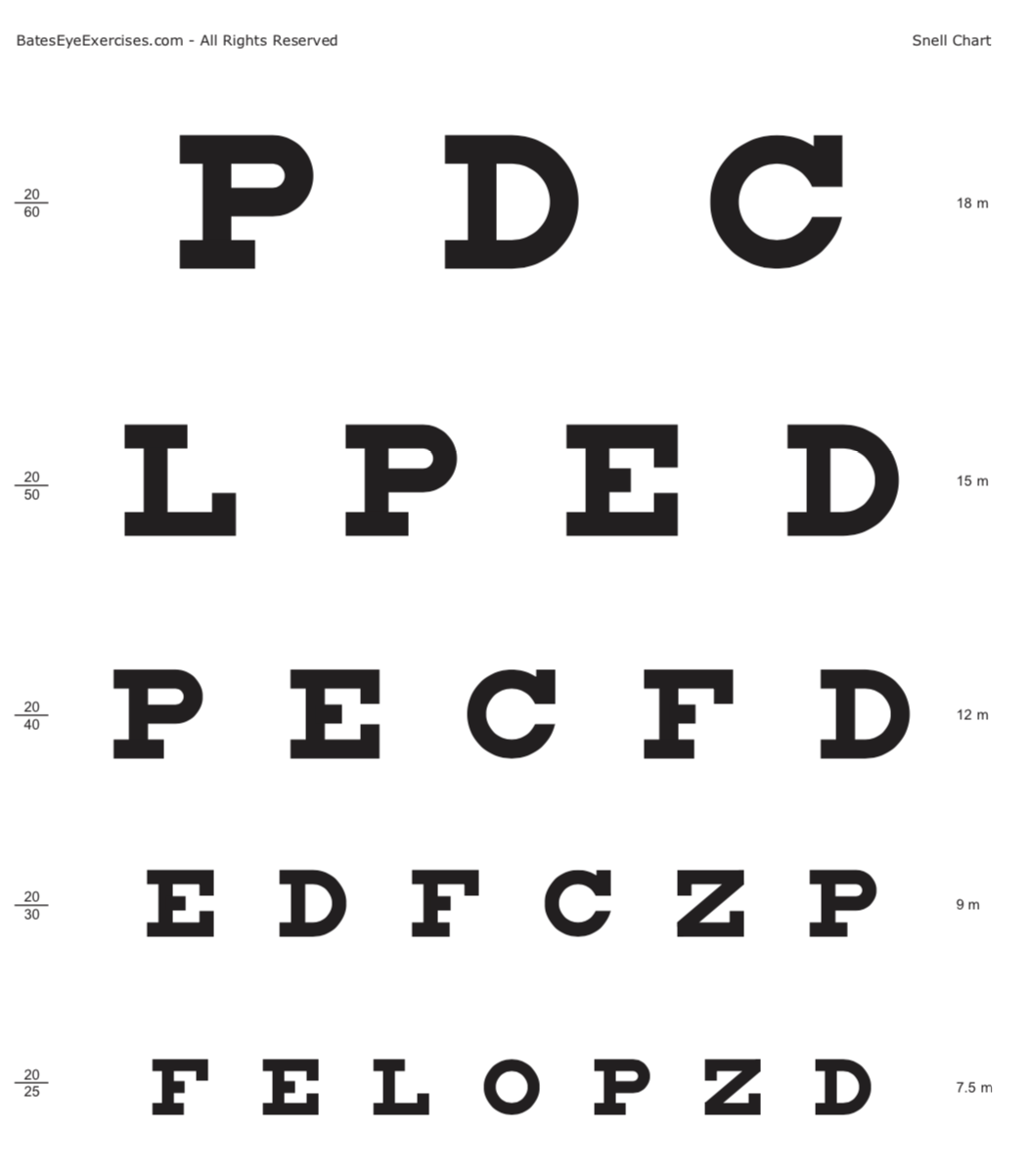
This is a basic exercise that works extremely well for nearsightedness. Even people with normal vision should use it as often as possible to maintain — or even improve — their vision beyond 20/20.
- Place the Snellen chart at a distance where you can clearly see about the top half of the chart, while the smaller rows below may be blurry or unreadable.
- Read the letters in each clearly visible row, one letter at a time. Try to trace their outlines and notice how clear and black they are. During this exercise, blink frequently and occasionally close your eyes and visualize the letter you just read. Imagine it even blacker and sharper.
- While reading the chart, you can also raise your hands out to the sides at eye level and wiggle your fingers and palms. This will stimulate your peripheral vision and relieve the strain of central vision.
Exercise K2. Stretching the oblique eye muscles
This exercise aims to relax the oblique eye muscles, which change the optical length of the eye and are essential for accurate, sharp vision.
- Hold up a pencil or your thumb and slowly bring it from down near your body up toward the tip of your nose. Keep looking at its tip until it touches your nose and your eyes converge on that point (you may see a double image close to your nose).
- Then move it horizontally to the right, keeping your gaze on it as it moves. Extend it out to about arm's length (or a little closer). Let your gaze follow as far as it comfortably can — the exact position of the thumb matters less than the movement itself. Pause briefly there, then bring it back toward your nose.
- As you move it away from your nose in each direction, inhale (the muscles tense); pause for 1–2 seconds; then exhale (the muscles relax) as you bring it back toward your nose.
- Repeat the same out-and-back movement upward, and then to the left, as in step 2. Keep the movements smooth, but stop if you feel pain. Do 2–10 complete cycles (down, right, up, left) depending on how tired your eyes feel.
Exercise K3. Exercise with two charts
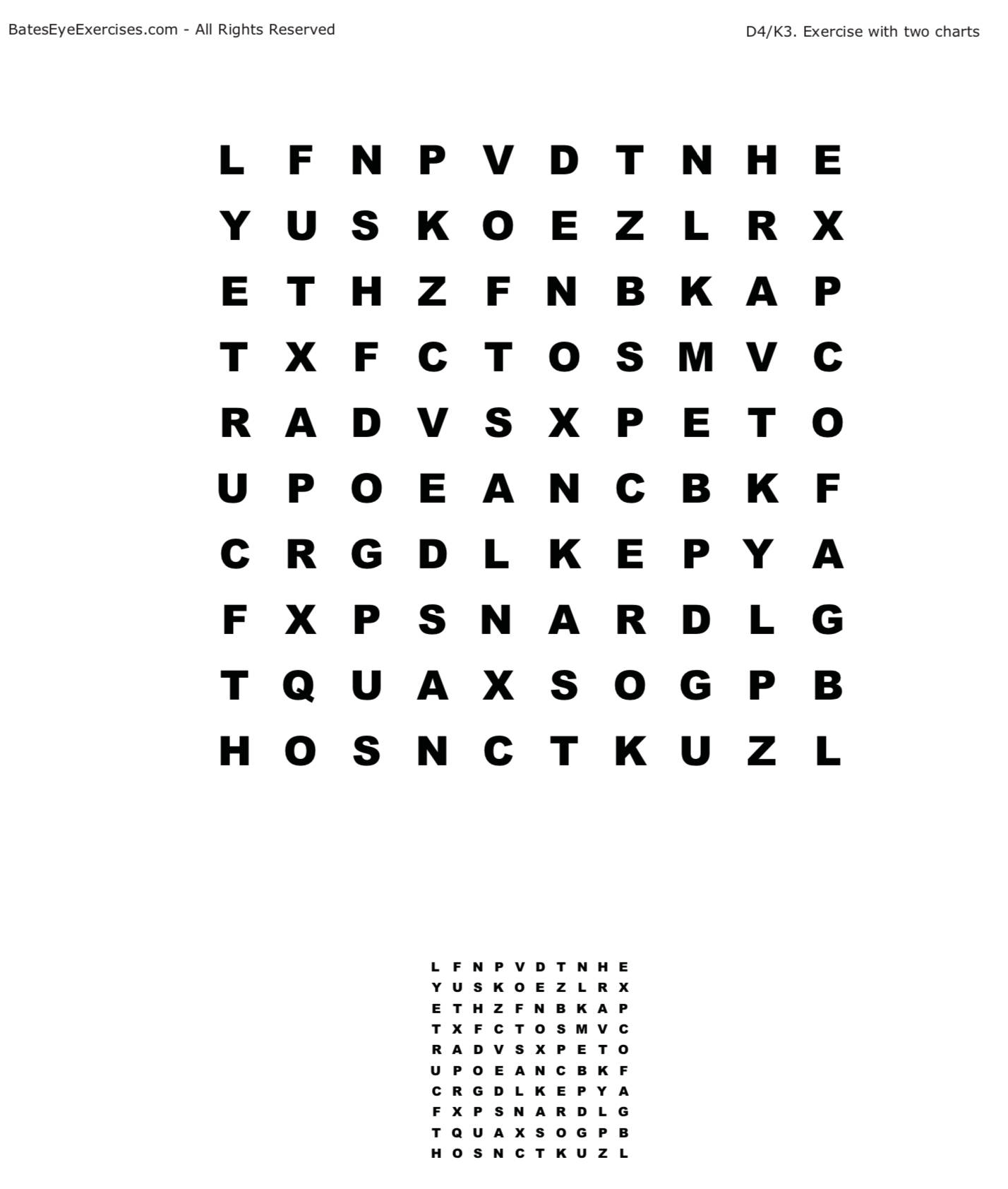
This exercise allows you to practice alternating between near and far vision, which improves eye accommodation and depth perception.
- For this exercise, you will need a special chart with letters for viewing from a distance and close up.
- Attach the large chart to a wall at a distance where you can see it relatively clearly, and hold the small chart in your hand.
- Read 3 consecutive letters from the small chart, close your eyes for a second, then look at the large chart and read the same letters. Do the same with the next 3 letters.
Exercise K4. String exercise
This exercise helps to assess your own range of good vision (near and far points) and serves to expand it.
- For this exercise, you will need a string about 1 m (3 feet) long, preferably a stretchy cord, as well as beads or other sliding markers. It's also a good idea to ask someone to help you.
- Measure your range of clear vision for each eye separately.
- Hold one end of the string at your cheekbone (slightly below the eye being tested). Attach the other end to something at eye level.
- Now find your near point of sharp vision, which should be somewhere in the range of 5–20 cm (2–8 inches), depending on the vision defect. Starting from the end of the string at your cheek, slide the marker outward. The goal is to find the point where you see the marker clearly and sharply, with no blur or smearing. Note this point.
- Now find the "far point" of clear vision. Starting from the other end of the string (extend your arm, or have someone help), slide the marker toward your cheek until you reach the farthest point where you can still see it clearly. Note this point too.
- With the "near point" and "far point" of clear vision marked, we can begin expanding the range of good vision by sliding the marker back and forth between them — going about 5 cm (2 inches) past each point. A stretchy string that you can pull closer or let out by hand works best. Breathe in calmly as the marker approaches your eye, and breathe out as it moves away. Do this for about 4 minutes at a time, but quite often throughout the day (up to 10 times). If one eye is weaker (a "lazy eye"), work with it more to bring its sharpness up to that of the stronger eye.
Exercise K5. Reading with "tromboning"
This exercise involves "tricking your eyes" by holding the text (a chart or book) very close to your eyes — from almost touching up to about 9 cm (3.5 inches). As you bring the chart closer, the print begins to blur, because the eye cannot accommodate at such a short distance. For a nearsighted person, the image momentarily focuses on the retina, or even beyond it (a kind of paradoxical farsightedness). As a result, the brain signals the eyes that straining the oblique muscles any further is pointless. This signal leads to the relaxation of the eye muscles — which is exactly what we are aiming for. At the same time, moving the book like a trombone helps expand your range of clear vision, thanks to the smooth change in accommodation.
- Set up the chart or book about 15 cm (6 inches) away and cover one eye. Slowly begin bringing the chart closer to your eye.
- When the print blurs, move your gaze along the letters and words without trying to recognize them. Blink from time to time.
- Now slowly reverse the movement until the text is perfectly sharp. Pause for a moment at this point and read one or two sentences.
- Then move the chart even farther away until the text is slightly blurred. Blink, and again bring the chart closer, to the point of maximum sharpness and then closer still, until the text is practically unreadable. Repeat steps 3 and 4 (tromboning) several times. This technique will increase your range of good vision for the "near point."
- Repeat the exercise for the other eye.
Exercise K6. Exercise with a calendar
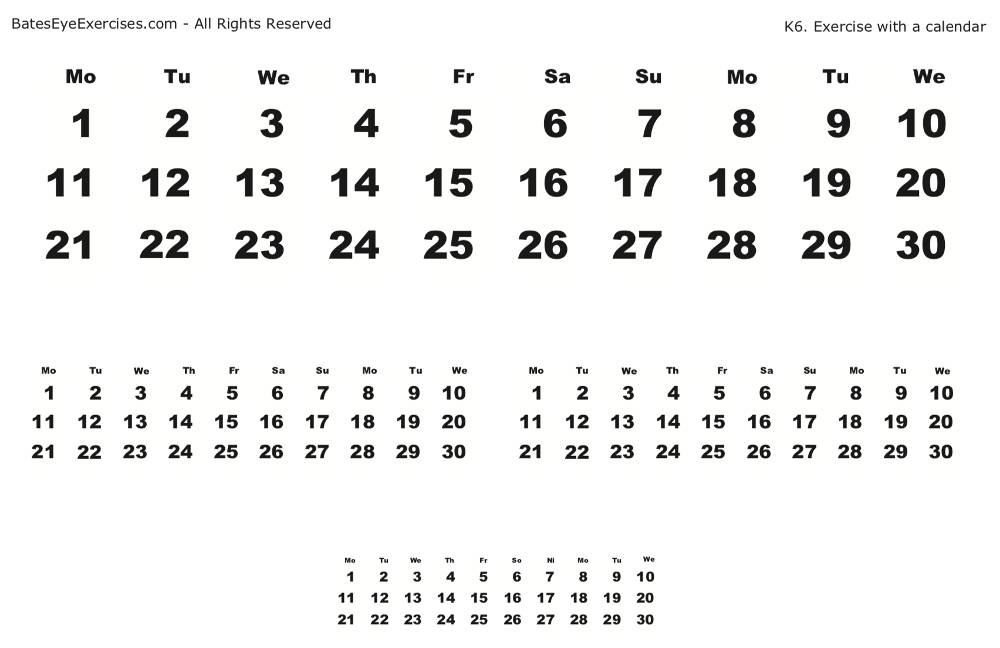
This exercise allows you to practice changing your eye accommodation, thus strengthening your visual acuity.
- For this exercise, you will need a special calendar chart with three different sizes of numbers.
- Attach the calendar chart to the wall at a distance where you can clearly see the largest numbers, have difficulty recognizing the middle ones, and are unable to read the smallest ones.
- Begin the exercise by looking at the first large number (1), closing your eyes, and turning your head to the right. Then open your eyes and return your gaze to the chart, stopping at the next number (here 2). Close your eyes again and turn your head to the left. Reopen your eyes and return to the chart, looking at the next number (in our example, 3), and so on until you reach the end of the first row (1–10). Perform a brief palming.
Primary source: W. H. Bates, Perfect Sight Without Glasses (1920), ch. 9 and 26–27 — full text at Wikisource.