Eye and Body Relaxation
Body relaxation
Relaxation is a state of the body in which the muscles loosen, breathing slows down and deepens, the heart rate slows, skin resistance changes, and so on. To describe the state of passive eye relaxation according to Dr. Bates, one must first mention relaxing and relieving tension in the entire body, as it is difficult to rest the eyes by relaxing their muscles while the whole body remains tense. Mental tension, neurotic states, anxiety, and stress cause tension in our muscles, including the eye muscles responsible for the quality and sharpness of vision. When the body is tired, the eyes cannot work properly. The basic principles of relaxation are as follows:
- Get enough sleep — it ensures rest for the body and, therefore, for the eyes as well.
- Give your whole body as much movement as possible through sports. We particularly encourage a weekly swim and recreational sports such as running, cycling, ice skating, rollerblading, or a simple evening walk. Choose what brings you the most joy, and your body and eyes will thank you in a very short time.
- Before starting vision exercises, perform a few of the relaxing exercises for the body and mind described below.
Exercise R1. Stretching exercises
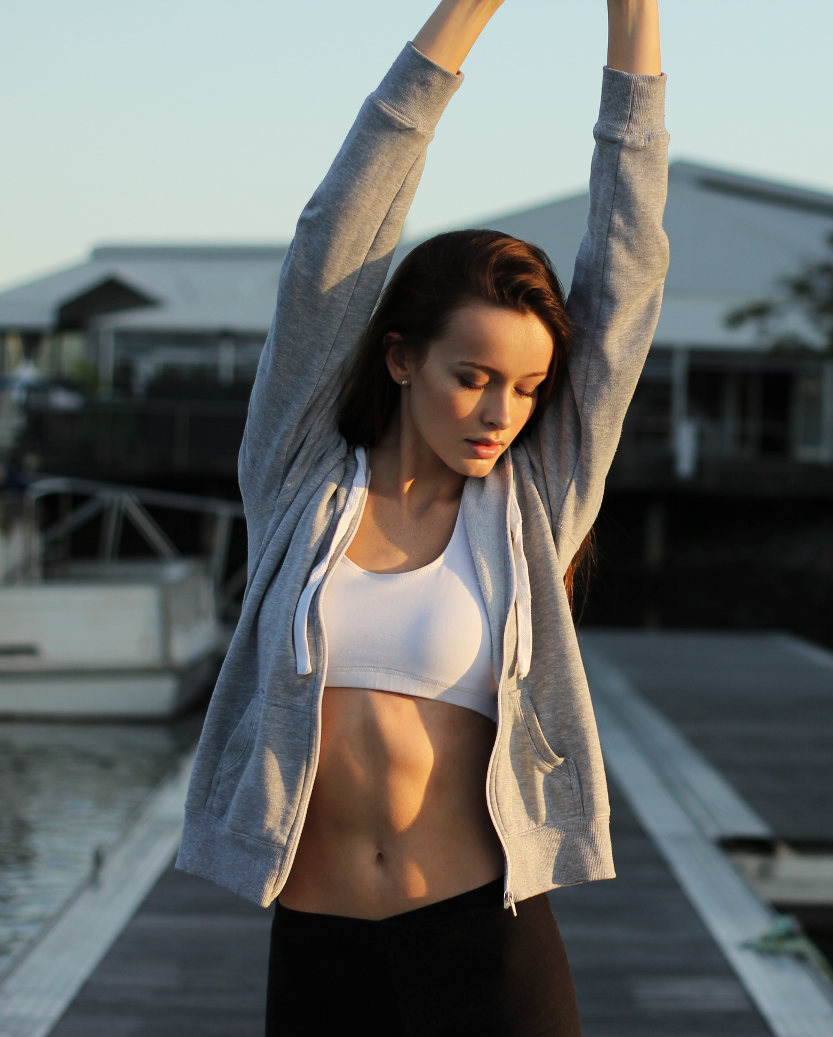
This exercise is a kind of warm-up that we should do before starting proper vision exercises. It takes just 2 minutes to relax our shoulders, neck, and upper body muscles, providing a good foundation for further exercises.
Stand up straight with your feet slightly apart and perform the following exercises:
- Make circular movements with your arms in one direction, and then in the other.
- Lean to the right so that your right hand slides down your right leg. Repeat to the left side.
- Make half-turns to the left and right with your upper body.
- Clasp your hands and make circular movements with both hands in front of you.
- Step up to a wall or door and, supporting yourself with your hands, do something like push-ups, moving your chest in and stretching your back muscles.
- Turn your neck five times to the right and left, keeping your head level.
- From the starting position (head straight), tip your head down to the left and back up five times, then repeat to the right.
- Lower your head so that your chin touches your chest, then turn it five times to the right and left, keeping it tilted down.
You can modify this set of exercises as you wish. The goal is to properly relax the upper half of the body, especially the neck and shoulders.
Exercise R2. "Brain Gym" exercises
The exercises below were introduced by Paul Dennison to stimulate the brain and the whole body before further practice. You don't have to do them all — choose the ones you like best.
Alternating Movements
Raise your right knee and touch it with your left elbow, then touch your right elbow to your raised left knee (the movement resembles marching in
place). This exercise stimulates large areas of both brain hemispheres at once, improving communication between them.
Lazy Eights
Draw or trace a lying figure eight (the infinity symbol) in the air with your hand. Always start the movement from
the center, going up and to the left — first with the left hand, then the right hand, and finally with both hands clasped together. This exercise integrates both hemispheres, relaxes the
hand and arm muscles, encourages eye tracking, and promotes smooth hand-eye coordination.
Lazy Eights for Eyes
Hold your thumb at eye level on the midline of your body, about an elbow's length away. Keep your head still but relaxed, and move only your eyes to follow the
thumb. Draw figure eights with your thumb, as described above. Continue with smooth, even movements at least 3 times with each hand. Then hold both hands
together with the thumbs forming an X. Focusing on the center of the X, track the joined thumbs as they trace the lazy-eight pattern. Lazy eights for
the eyes are similar to lazy eights for writing, but here we focus on eye movement and on improving hand-eye and eye-hand coordination.
Palming theory
Eye relaxation can be achieved by closing the eyes and covering them with your palms so as to block out all light. Simply shutting off visual sensations is sometimes enough to create a state of deep relaxation. However, covering and closing the eyes is ineffective if mental tension is not removed at the same time. If you perform palming perfectly, you will see a field of blackness so deep that you could not picture or imagine anything darker; and the moment you can do this, your vision will be correct.
People whose vision is not functioning properly may at first have serious difficulty achieving full blackness in front of their eyes. The field of view, due to tension within the eye socket, will be filled with gray clouds, bright streaks, and moving lights and colors.
Exercise R3. Palming (covering the eyes)
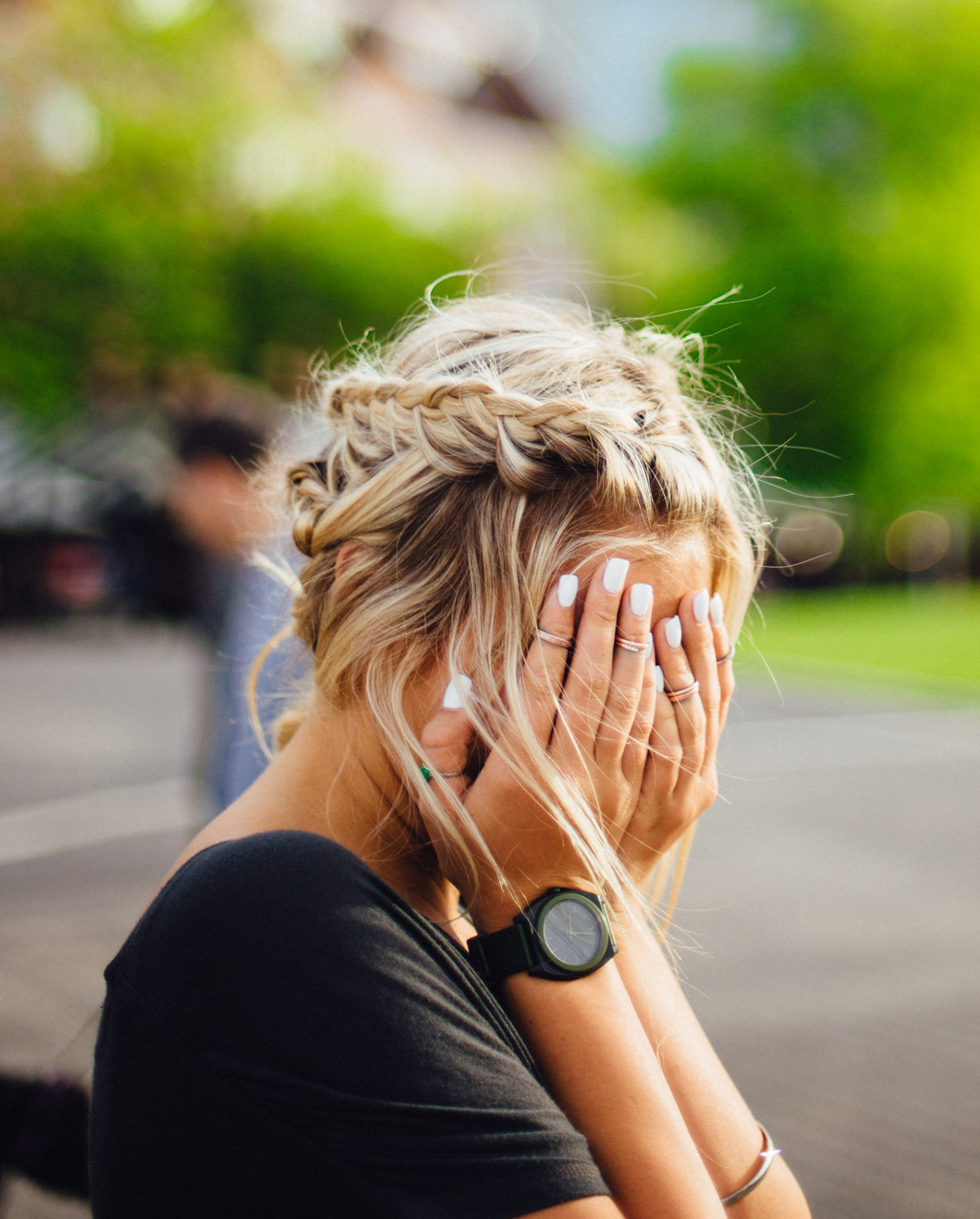
- If you are sitting at a table, assume a position where your elbows rest on the table (you can use a cushion) or rest your elbows directly on your knees.
- Cover your eyes with your crossed hands so that no light reaches them. Your fingers should rest on your forehead, the lower part of your hands on your cheekbones, and the edges should touch your nose without pressing on it. Position your hands so that your eyes can still blink freely. If you like warmth, rub your hands together before placing them over your eyes. People with rested vision will find that their whole field of view fills with uniform blackness. Others will see flashes of light, swirling colors, grays, and other visual illusions.
- Visualize darkness and blackness. Breathe slowly through your nose (in and out). Feel your muscles and the various parts of your body (shoulders, arms, legs, thighs, feet, ribs, etc.) expand as you inhale and relax as you exhale.
- Imagine, for example, that your house is black, and the city is black, and then the country and the continent. You can picture any object or place that you strongly associate with the color black: black paint, a black piano, black patent-leather shoes, a dark night, a deep well, and so on. Focus on this object and imagine how dark it is. The deeper the blackness in front of your eyes, the more relaxed your vision will be.
- Your eyes can be closed or open, whichever is more comfortable for you.
- Make a few small eye movements — up and down, right and left, and in a circle.
- Slowly open your eyes and notice how relaxed and at ease they now feel — and how this improves your vision.
Sunlight exposure theory
In today's world, where sunglasses are everywhere, many people are poorly accustomed to bright light or to sudden changes in it. For most of history, sunny days posed no obstacle to the human race, and learning to tolerate natural light comfortably is part of healthy vision. This does not mean abandoning eye protection in genuinely harsh conditions — only that gentle, gradual exposure to daylight can help retrain the eyes.
Adapting to respond properly to light is one of the fundamental ways of practicing the art of conscious vision. For eyes that see properly and remain in a state of relaxation, sunlight is essential.
According to Dr. Bates, "sunbathing", thanks to the bactericidal properties of sunlight, has a therapeutic effect on various inflammatory conditions of the eyes and eyelids. It also relaxes harmful tension in the eye muscles, reduces sensitivity to glare and bright light, and helps eliminate the fear of light and the need to frown or squint. It is also the first stage in learning the passive and dynamic relaxation of the eyes, which is a necessary condition for vision re-education.
Exercise R4. Solarization
- Stand or sit where you can face the sun. On an exceptionally sunny day, it is enough to face the brightly lit sky. If the season is unfavorable or there is no sunny spot, use a lamp with a bulb of at least 100 watts.
- Close your eyes and slowly turn your face toward the sun, sky, or bulb.
- Move your head gently and slowly from side to side about 20–30 times. Continuous head movement is essential to keep the retina from being exposed to light too long in one spot. If you are very sensitive to sunlight, start by facing the sky rather than the sun directly.
- Then palm for at least 1 minute, breathing deeply and slowly.
- You can repeat steps 3–4 depending on how much time you have. Now and then, try devoting about 20 minutes to this to see how much it rests your eyes and stimulates your irises. Keep moving your head so the same part of the eye is not exposed for too long. If you feel any discomfort, turn your head away from the sun and cover your eyes briefly with your hands.
Exercise R5. Energizing your eyes
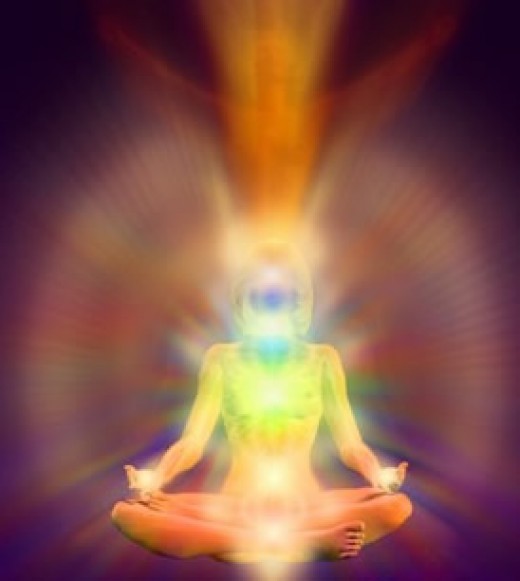
The eyes and the whole process of vision are said to use a large share of the body's available energy, which is why it is important to supply that energy to your eyes. The purpose of the following exercise is to clear your eyes of old, used energy and fill them with fresh, healthy energy. It has been adapted from Leo Angart's book "Improve Your Eyesight Naturally". The exercise may seem amusing, and its goal may seem small, but don't be fooled — give it at least two weeks. It is an excellent complement to the relaxation phase and is best done at the end of those exercises, to give your eyes enough energy before more strenuous ones. It is also worth mentioning that some people report reducing significant vision defects (around 2 diopters) with this exercise alone in a relatively short time, doing it every half hour throughout the day.
The exercise should be performed at least 3 times a day (ideally at the end of relaxation exercises).
- Touch your fingertips to the centers of your palms, then shake your hands vigorously.
- Imagine a soft energy the color of a green apple flowing from the centers of your palms to your bent fingers as green rays of energy.
- Close your eyes and direct this green energy straight into the energy center in the middle of your eyes (between the eyebrows). Imagine an endless stream of refreshing green energy flowing from your hands directly into your eyes, filling them with cleansing green energy. Visualize the energy filling your eyes, from the lens all the way to the central pit, and traveling to the muscles surrounding the eyes and the optic nerve. Take 6–8 deep breaths while transferring the energy, then lower your hands.
- Next, imagine that you are wearing a glove of transparent green energy that extends about 10 cm (4 inches) beyond your fingers. Use it to sweep away the old, used energy from your eyes. Be sure to clear it from every corner of the eyes — from the back, through the cornea, the vitreous body, and the surrounding muscles, and finally to the lens and eyebrows. You will feel the used energy being drawn out of your eyes.
Exercise R6. Blinking
Dust in the air settles on the surface of our eyes, which is why frequent, easy blinking is essential for cleansing and moistening the eye's surface. Blinking is also the simplest way to give the eyes a moment of relaxation. People with vision problems tend to blink very rarely, staring and bulging their eyes instead, whereas those who use their vision naturally blink often and effortlessly. Unfortunately, when tension is present, there is a tendency to blink too rarely and to work the eyelids under strain. Blinking also breaks the harmful habit of staring.
The roles of blinking include lubricating and cleansing the eyes with tears and giving them a moment of passive rest (a brief shading) by shielding them from the light source. It is therefore very important to blink as often as possible (every 1–3 seconds), which will keep your eyes moist and relaxed.
- Make 6–10 quick, easy blinks, then cover your lightly closed eyes for a few seconds.
- Then make 10–20 blinks and cover them again for a few seconds.
Exercise R7. Chinese eye acupressure
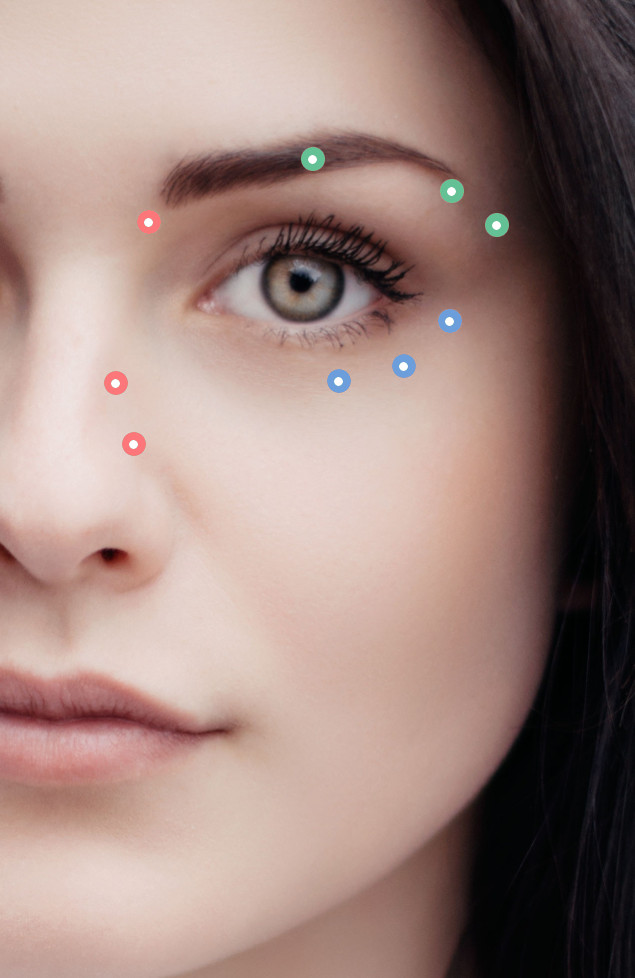
Use the pad of your thumb or index finger, whichever makes it easier to press a given point. All the points are marked on the illustration, and you can find their exact location easily, since they feel notably tender when pressed. Gently massage and press each point to unblock the energy flow. Adjust the pressure so that it does not cause sharp pain, increasing it gradually as you massage the point.
- 3 green points on the upper rim of the eye socket. Massage them in small circles with gentle pressure.
- 3 blue points on the lower rim of the eye socket. Here you can also use several fingers to massage the whole lower rim.
- 3 red points around the nose, as shown in the illustration.
Exercise R8. Alternating eye movements
- The exercise can be done standing or sitting.
- Move your eyes up and down several times, keeping your head still. Let your gaze move gently, without focusing on the objects around you.
- Now make similar movements, this time from left to right and back again, also several times.
- Next, move diagonally, from the lower left to the upper right.
Primary source: W. H. Bates, Perfect Sight Without Glasses (1920), ch. 12 (palming) and 17 — full text at Wikisource.